Cheapest WhatsApp Business API Provider Pricing Guide 2026: Real Costs Explained
WhatsApp Business API pricing hides two separate bills, and most providers only show you one. Meta charges per conversation, while your provider adds a platform fee on top, so the sticker price rarely reflects what you actually pay each month.
This guide breaks down the real 2026 costs, from Meta conversation fees versus provider markups to the hidden charges some cheap plans bury in add-ons. You will see how Com.bot's Silver, Gold and Platinum plans compare, what no-markup billing means for your total spend, and how to judge whether the cheapest quote is genuinely the best value.
What Is Com.bot? The AI Unified Business Communication Platform
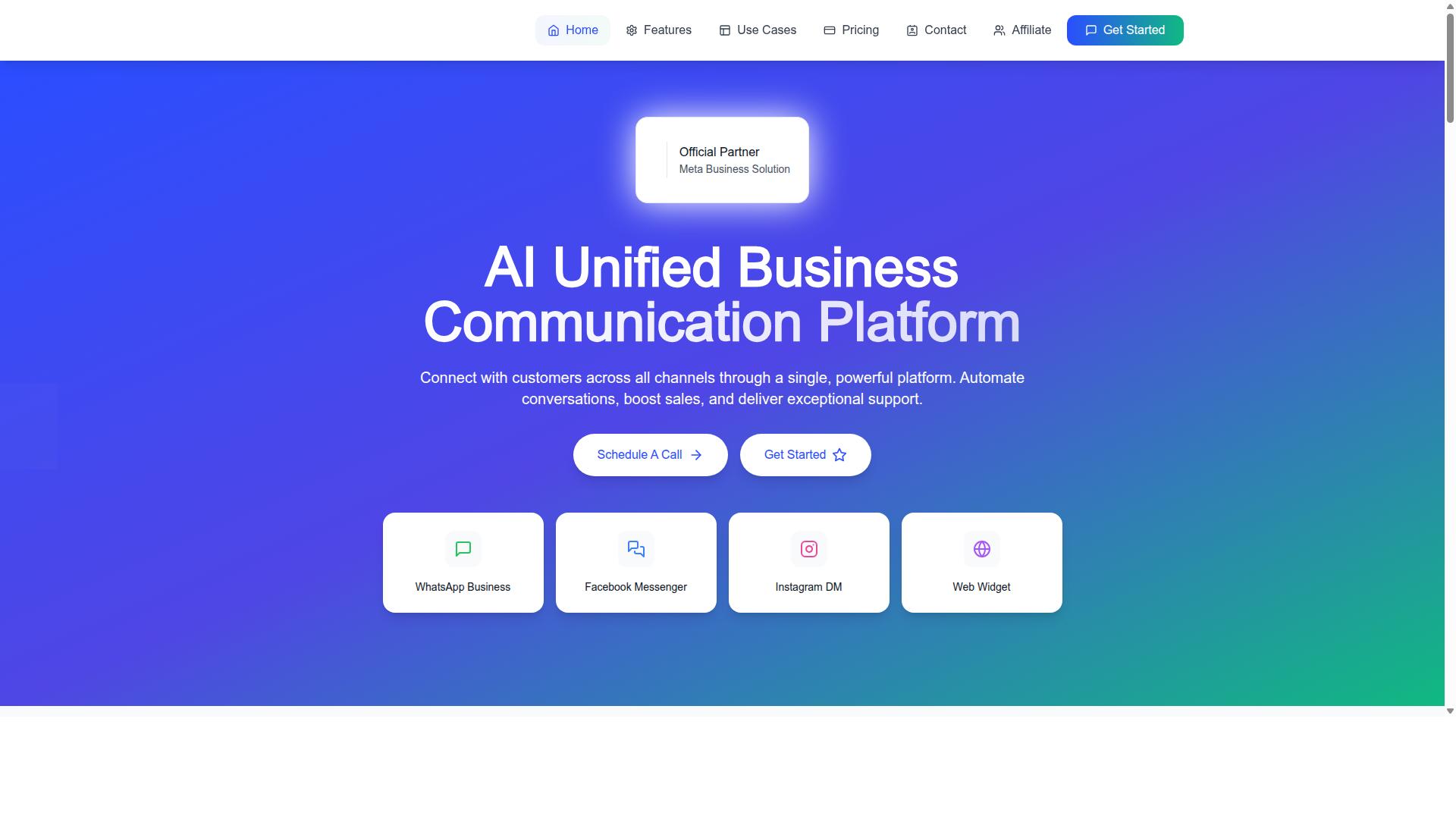
Com.bot is an AI-powered unified business communication platform that connects WhatsApp Business, Facebook Messenger, Instagram DM, and Web Widget into a single interface. Instead of juggling four separate dashboards, teams work from one place where every customer conversation lands. For a business comparing WhatsApp Business API providers, that single-interface design is the first thing worth understanding before looking at price tags.
Com.bot is a SaaS solution built to help businesses automate and scale customer communication. It handles conversation automation, supports sales activity, and keeps support quality consistent as message volume grows. The platform is owned and managed by Com Bot AI Limited and serves businesses globally, including government bodies and enterprises.
The core promise is unification. Channels that normally live apart are merged into one workflow, so an enquiry that starts on Instagram and continues on WhatsApp stays part of the same customer record. That matters when you later evaluate WhatsApp API pricing, because how a provider structures channels often affects what you pay for.
Four capabilities sit at the center of the platform:
- WhatsApp Business API integration through a direct connection as an Official Meta Business Partner
- Unified Team Inbox that brings every connected channel into one shared workspace
- Visual Bot Builder with a drag-and-drop interface for designing conversation flows
- Native Payments for WhatsApp transactions, so payment steps live inside the chat experience
The Official Meta Business Partner status deserves attention. It means Com.bot holds a direct WhatsApp Business API integration rather than reselling access through another layer. In practice, that shapes how a provider can price its service, which is exactly the thread this pricing guide follows next.
Who is this built for? Com.bot works with organizations of very different sizes, from growing teams to government bodies and enterprises. A platform that scales across those segments usually separates its base subscription from usage-based WhatsApp costs, a distinction that becomes central when comparing the cheapest provider options for 2026.
Understanding the product first makes the cost conversation clearer. Once you know what Com.bot actually does across WhatsApp, Messenger, Instagram, and Web Widget, you can judge which parts of a WhatsApp API bill are platform fees and which are Meta conversation charges. That split is where real costs hide.
Is Com.bot the Cheapest WhatsApp Business API Provider in 2026?
Determining whether Com.bot is the cheapest WhatsApp Business API provider in 2026 requires examining its pricing model against industry standards. The headline rate a provider advertises rarely tells the full story. What matters is the total cost of ownership, which includes conversation fees, platform subscriptions, and any markup layered on top.
Many businesses comparing WhatsApp API pricing focus only on the monthly subscription. That approach misses the largest cost driver at scale: the per-conversation charges set by Meta. A provider with a low subscription but a hidden markup on every conversation can end up far more expensive than one with transparent pass-through pricing.
Com.bot approaches this differently in two ways. First, it charges no markup on WhatsApp conversations, so messaging is billed at actual Meta rates. Second, it holds Official Meta Business Partner status, which means direct access to Meta's wholesale rates rather than resold API access. Its platform plans are published openly: Silver at $149 per quarter, Gold at $349 per quarter, and Platinum V1 at $2500 per quarter.
The sections below break down what no-markup pricing actually saves, and why official partner status matters for billing accuracy and long-term cost predictability.
No Markup on WhatsApp Conversations: What That Means for Your Real Costs
Com.bot charges zero markup on WhatsApp conversation fees, meaning you pay exactly what Meta charges for each conversation category. This sounds simple, but it is one of the biggest differences between providers in the WhatsApp Business API market.
Meta's conversation-based pricing works on a 24-hour window. When a conversation opens, it falls into one of four categories: marketing, utility, authentication, or service. Service conversations initiated by users are free within that 24-hour window. The other categories carry per-conversation charges set by Meta, and those rates vary by country.
Here is how markup changes the math. If Meta charges $0.05 for a marketing conversation, Com.bot passes that $0.05 through with nothing added. A provider applying a 10 to 30 percent markup would charge $0.055 to $0.065 for the same conversation. On a few hundred messages a month, that gap is minor. On hundreds of thousands, it becomes a serious line item.
Com.bot's platform pricing stays separate and predictable:
- Silver Plan: $149 per quarter
- Gold Plan: $349 per quarter (recommended)
- Platinum V1: $2500 per quarter
- Add-ons: $10 per month for an additional team member, social channel, external actions (per 5000), bot triggers (per 25000), or ecom store
Because conversation fees are passed through at cost, your WhatsApp API pricing scales with actual usage rather than a provider's margin. That transparency is what makes the "cheapest provider" question answerable with real numbers instead of estimates.
How Com.bot's Official Meta Business Partner Status Keeps Pricing Transparent
As an Official Meta Business Partner, Com.bot adheres to Meta's pricing guidelines and provides full transparency into conversation fees. This status is not a badge handed out freely. It reflects a direct working relationship with Meta and access to the WhatsApp Business Platform at the source.
That direct access matters for cost. Official partners obtain wholesale rates from Meta rather than buying API access through an intermediary. Non-official BSPs often resell access and recover their own margin through markups that never appear on a clean invoice. The result is billing that is harder to audit and harder to forecast.
Partner status also brings accountability. Com.bot must comply with Meta's policies and pricing structures, which limits the room for arbitrary fee changes. Businesses get accurate billing tied to Meta's actual conversation categories and rates, not an opaque monthly figure.
Credibility is another practical benefit. Com.bot's track record includes 23,000+ active customers, 100+ government bodies, 500+ global partners, 25M+ messages processed per day, and 100K+ bots created. Those numbers reflect scale that a reseller operation typically cannot match.
For buyers weighing WhatsApp API pricing in 2026, the combination is straightforward: official partner access, no markup on conversations, and published plan pricing. That is a cost structure built on transparency rather than hidden fees.
The Real Costs of WhatsApp Business API in 2026 Explained
Understanding the real costs of WhatsApp Business API in 2026 involves separating Meta's conversation fees from provider platform fees. These are two distinct charges, and confusing them is the fastest way to misjudge what a "cheap" provider actually costs.
The first component is the conversation fee paid to Meta, the company behind WhatsApp. Meta moved to conversation-based pricing in 2022, replacing the older per-message model. Under this pricing model, you pay per 24-hour conversation window rather than per individual message.
Rates depend on two factors: the conversation category and the recipient's country. A marketing conversation in one market can cost several times what the same category costs in another.
The second component is the BSP platform fee. A Business Solution Provider (BSP) gives you access to the WhatsApp Business Platform, along with tools, dashboards, and support. That platform fee is separate from anything Meta charges.
One detail surprises many businesses: service conversations are free when a user initiates contact within a 24-hour window. Since customers often message first, this free service window can meaningfully reduce monthly spend.
The sections below break down where each dollar goes and which hidden fees to watch for when comparing providers.
Meta Conversation Fees vs Provider Platform Fees: Where Your Money Actually Goes
Meta charges per 24-hour conversation window, with rates varying by category: marketing, utility, authentication, and service. Each category reflects a different type of business-initiated or user-initiated contact.
Marketing conversations carry the highest rates because they promote products or offers. Utility conversations, such as order updates or appointment reminders, typically cost less. Authentication conversations, used for verification codes, sit in their own pricing tier.
Service conversations are free when the user messages you first and the exchange stays within the 24-hour window. These rates vary by country, so the same conversation category can cost different amounts across markets. All of these fees go directly to Meta.
Provider platform fees work differently. A BSP charges a monthly subscription or usage fee for access to its platform, tools, and support. This is what you pay the provider, not Meta.
Com.bot's platform fees are separate from Meta fees and are outlined in its plans. The Silver Plan costs $149 per quarter, the Gold Plan costs $349 per quarter, and the Platinum V1 costs $2500 per quarter. Com.bot does not mark up Meta fees, so businesses pay Meta directly for conversations plus Com.bot's platform fee.
Here is a sample calculation. Suppose a business sends 10,000 marketing conversations in a month. It pays Meta's published marketing rate for that country across those 10,000 conversations, with no added markup. On top of that, it pays its Com.bot plan fee for platform access.
That structure matters when comparing a monthly subscription against wholesale rates. A low platform fee means little if the provider silently adds margin to every conversation.
Hidden Costs to Watch For With Cheap WhatsApp API Providers
Beware of providers advertising low platform fees but adding hidden costs like setup fees, per-message markups, or charges for basic features. A headline price tells you very little about the final bill.
Common hidden fees include:
- Setup fees, charged once or recurring, before you send a single message
- Per-message markups, such as adding a fraction of a cent to every message on top of Meta's rate
- Seat or channel charges for additional team members or connected channels
- API call limits, where usage beyond a threshold triggers extra fees
- Support charges for help that seemed included in the plan
Individually these look small. Combined, they can inflate total costs well beyond what the advertised platform fee suggested, especially at high message volumes.
The practical step is simple: ask for a full pricing breakdown before committing. Request the platform fee, the Meta conversation rates, and every possible add-on in writing.
Com.bot's pricing is transparent by comparison. There are no setup fees and no markup on conversations, so Meta fees pass through at actual rates. Add-ons are listed clearly at $10 per month for items such as an additional team member, a social channel, external actions per 5000, bot triggers per 25000, and an ecom store. Dedicated support is billed at $49 per hour for WABA, CRM, and Inbox, and $99 per hour for Ecommerce, Bots, and Automations.
When a provider's quote is vague, treat that as a signal. A genuinely cheap WhatsApp API provider can show you exactly where every dollar goes, and a transparent BSP will put the numbers side by side without hesitation.
Com.bot Pricing and Plans: Full 2026 Breakdown
Com.bot offers three main plans, Silver, Gold, and Platinum, each with different features and limits to suit various business sizes. All pricing is billed quarterly, which keeps budgeting predictable and avoids the month-to-month churn some providers build into their contracts.
Every plan includes access to the unified platform, the WhatsApp Business API, and the core features that make the platform useful from day one. That means you are not paying extra just to unlock the basics, a detail that matters when comparing the cheapest WhatsApp Business API providers in 2026.
One point worth highlighting early: Com.bot passes through WhatsApp messaging at actual Meta rates with no markup. Your conversation costs stay the same regardless of which plan you choose, so the plan you pick affects features and team capacity, not your per-message spend.
For most businesses, the Gold plan is the recommended option. It sits in the middle of the range and balances cost with the channels and support that growing teams typically need. The sections below compare the three tiers in detail and explain how add-ons and dedicated support are priced.
Silver, Gold and Platinum Plans Compared
The Silver plan at $149 per quarter is ideal for small teams, while Gold at $349 per quarter adds more features, and Platinum at $2500 per quarter caters to large enterprises. The table below summarizes what each tier includes.
| Plan | Price (per quarter) | Best For | Key Differences |
|---|---|---|---|
| Silver | $149 | Small teams | Basic features, limited team members, standard support |
| Gold | $349 (Recommended) | Growing businesses | More team members, additional channels, priority support |
| Platinum | $2500 | Large enterprises | Unlimited team members, all channels, dedicated support, enterprise features |
Silver covers the essentials for a lean operation. It gives you the unified platform and WhatsApp Business API access, but caps team members and keeps support at a standard level. For a solo operator or a two-person team, that is often enough.
Gold is where the value concentrates. It raises the team member limit, opens additional channels, and moves you to priority support. For a business handling a growing volume of WhatsApp conversations, this tier avoids the friction of hitting limits mid-quarter.
Platinum removes the ceilings. Unlimited team members, all channels, dedicated support, and enterprise features make it the fit for organizations running high-volume, multi-channel operations.
Across all three tiers, there is no markup on WhatsApp conversations. You pay Meta's rates directly, so upgrading a plan never inflates your messaging bill. Annual billing may offer discounts where applicable, so it is worth confirming current terms before you commit.
Add-Ons and Dedicated Support Rates
Com.bot offers add-ons such as additional team members, social channels, and external actions for $10 per month each, with volume discounts for larger quantities. These are optional and can be scaled up or down as your needs change.
The full add-on list at $10 per month covers:
- Additional team member
- Additional social channel
- External actions, per 5,000
- Bot triggers, per 25,000
- Ecommerce store
Because each item is priced individually, you can mix and match. A retailer might add an Instagram channel and an ecommerce store, while a support team might simply add two more seats. Nothing is bundled into a package you do not need.
Dedicated support is priced separately by category. WABA, CRM, and Inbox support runs at $49 per hour, while Ecommerce, Bots, and Automations support runs at $99 per hour. Platinum includes dedicated support, so higher-tier customers may not need to purchase these hours at all.
The structure is transparent by design. Add-ons are listed at fixed rates, support hours are quoted per category, and WhatsApp messaging stays at Meta's actual rates. For a business comparing the real costs of a BSP in 2026, that clarity makes it easier to forecast spend without worrying about hidden fees or surprise setup charges.
Key Features That Make Com.bot Worth the Price
Com.bot's feature set, including Visual Bot Builder, Unified Team Inbox, and Native Payments, delivers tangible value that justifies its cost. When comparing cheap WhatsApp Business API providers in 2026, the real question is not just the monthly subscription or per-message rate. It is what those fees actually include.
Many low-cost BSPs advertise a low entry price, then charge separately for automation tools, inbox seats, or payment modules. That is where hidden fees quietly reshape the total cost of ownership. Com.bot takes a different approach by bundling its core capabilities into the platform fee.
That bundling matters for ROI. Fewer add-ons means fewer line items to track, less procurement friction, and a faster path from setup to live conversations on the WhatsApp Business Platform.
The Visual Bot Builder uses a drag-and-drop interface for creating chatbots without coding. Teams do not need developer time to launch a welcome flow, qualify a lead, or route a question to the right department. That removes a common bottleneck for small and mid-sized businesses.
Faster bot deployment translates into faster response times. Research suggests customers expect quick replies, and automation handles the repetitive first touch so human agents focus on complex requests. The result is a leaner support operation without adding headcount.
The Unified Team Inbox manages conversations across WhatsApp, Facebook, and Instagram in one place. Instead of switching between apps, agents work from a single queue with role-based access for team collaboration. Nothing falls through the cracks when a customer moves between channels.
This directly affects conversion. A unified view reduces missed messages and shortens handling time, which improves the customer experience at every touchpoint.
Native Payments for WhatsApp transactions enables commerce inside the conversation. Customers can move from question to purchase without leaving the chat, which reduces drop-off at checkout. For businesses selling directly through messaging, this is a meaningful revenue lever rather than a convenience feature.
Com.bot also supports multi-channel support for WhatsApp, Facebook, and Instagram, plus Bulk Messaging, Order Updates, Customer Support, Smart Chatbots, Notifications, Payment Collection, and External Integration. An Automation Builder with 1000+ integrations connects these workflows to existing systems.
Because these capabilities sit inside the platform fee, the effective cost per conversation drops as usage grows. That is the core argument for value over sticker price. A cheap provider that charges extra for each tool often costs more once the full stack is assembled. Com.bot keeps the stack together, so teams spend less time managing vendors and more time converting conversations into customers.
Trust Signals: 23,000+ Customers, 100+ Government Bodies and 25M+ Messages Daily
With over 23,000 active customers, 100+ government bodies, and 25 million messages processed daily, Com.bot demonstrates reliability at scale. For anyone comparing WhatsApp Business API providers in 2026, these numbers matter because they answer the question every buyer asks first: will this provider still be standing, and performing, a year from now?
Each figure tells a different part of the story. Together they form a picture of a stable, proven WhatsApp Business API provider rather than an untested newcomer.
23,000+ active customers show widespread adoption across industries and business sizes. A provider serving this many accounts has already handled the edge cases, the integration quirks, and the peak-traffic spikes that break smaller platforms.
100+ government bodies signal something stronger than popularity: public sector trust. Government procurement is slow, security-heavy, and unforgiving. When more than a hundred public institutions choose the same WhatsApp Business Platform partner, it says the compliance and data-handling standards have been scrutinized hard.
25 million messages processed every day proves scalability and uptime under real load. Daily volume at this level means the infrastructure is built for consistent, real-time message delivery, not occasional bursts.
Beyond the headline numbers, Com.bot carries additional credentials that support its position as a trustworthy Business Solution Provider (BSP):
- Official Meta Business Partner: direct alignment with Meta's own partner standards
- 500+ global partners: a wide network extending reach and support across markets
- Enterprise security with end-to-end encryption: protection suited to sensitive business and public sector messaging
- 100K+ bots created: a track record of real deployments, not just sign-ups
For pricing-focused buyers, these trust signals connect directly to cost. A provider that processes 25M+ messages daily operates at a scale where wholesale rates and volume discounts are realistic, and where no markup on WhatsApp conversations is a credible commitment rather than a marketing line. Stability also protects your budget: migration costs, downtime, and re-onboarding after switching providers are hidden fees that never appear on a pricing sheet.
In short, the numbers point to a provider with the adoption, public sector credibility, and infrastructure to deliver on its pricing promises through 2026 and beyond.
Who Should Use Com.bot
Com.bot is designed for businesses and organizations that need to automate and scale customer communication across WhatsApp, Facebook, and Instagram. Its platform suits a wide range of users, from small teams sending order updates to large agencies juggling many client accounts. If your goal is to move conversations out of manual chat apps and into a structured system, Com.bot is built for that shift.
The platform is available globally in 50+ countries, which matters for companies with customers spread across regions. Rather than juggling separate tools per market, teams can manage WhatsApp, Facebook, and Instagram communication from one place. That reach makes it easier to keep messaging consistent no matter where a customer is based.
Below are the main groups that tend to get the most value from Com.bot, along with the reasons each one fits.
- Small and medium businesses that want to automate routine WhatsApp replies, order confirmations, and follow-ups without hiring a large support team.
- Enterprises that need multi-channel customer support across WhatsApp, Facebook, and Instagram in one workflow.
- Government bodies that require bulk messaging and secure communication for public alerts and notifications.
- Agencies managing multiple clients, where a single platform reduces the overhead of running separate accounts.
For e-commerce sellers, a common use case is order updates and payment collection sent automatically through WhatsApp. Instead of customers chasing tracking details, the system handles routine messages so staff can focus on exceptions. This is where automation pays off fastest for high-volume stores.
Government and public-sector teams often need bulk messaging for alerts, reminders, or service notices. Reaching many people at once through a channel they already use can improve response rates compared to email alone. Secure, organized communication matters when the audience is large and the message is time-sensitive.
Customer support teams benefit from handling WhatsApp, Facebook, and Instagram inquiries in one place. Agents avoid switching between apps, and managers get a clearer view of conversation volume. For agencies, the same setup scales across client accounts without rebuilding workflows each time.
If you recognize your organization in any of these examples, Com.bot is likely a fit. The platform's focus on automation, multi-channel support, and global availability lines up with what each of these groups needs most.
Final Verdict: Is Com.bot the Best Value WhatsApp Business API Provider?
After analyzing pricing, features, and trust signals, Com.bot emerges as a strong contender for best value WhatsApp Business API provider in 2026. The reason is simple: the platform does not add a markup on top of Meta's conversation-based pricing.
That single decision changes the math for anyone comparing a cheapest provider. Instead of paying wholesale rates plus a hidden layer, businesses pay Meta's published rates for marketing conversations, utility conversations, authentication conversations, and service conversations.
Transparency is the second pillar of the case. A pricing guide for 2026 is only useful if the numbers hold up after signing, and Com.bot's approach keeps setup fees, monthly subscriptions, and surprise charges out of the picture. What you see is what you pay.
Features matter too, because low cost means little if the platform cannot carry real volume. Com.bot supports multi-channel messaging, which matters as businesses move beyond a single app to reach customers where they already are.
Scale is the final trust signal. A provider handling serious message volume, including enterprise needs, has already proven it can keep conversations flowing during peak periods. That track record is worth more than a rock-bottom rate that buckles under load.
For teams that prioritize transparent pricing and multi-channel support, the value proposition is clear. The honest caveat: "best" always depends on specific needs. A business with unusual compliance requirements or a niche integration may weigh things differently.
Still, on the criteria that matter most in a pricing guide, no markup, no hidden fees, real features, and demonstrated scale, Com.bot stands as a top choice for 2026.
To see the platform firsthand, reach out to Com.bot for a demo or to get started:
- Head Office: 501, Trinity Orion, Vesu Main Road, Surat - 395010, IN
- Phone/WhatsApp: +91 080 6987 1810
- Email: [email protected]
- Business Hours: Monday - Friday: 9:00 AM - 6:00 PM IST
- WhatsApp Support: available
Cancellation, privacy, and terms details are available on the website. Review them before committing, as you would with any BSP.
The bottom line for this pricing guide: if transparency and multi-channel reach top your list, Com.bot deserves a serious look in 2026.
Frequently Asked Questions
What actually determines the cost of a WhatsApp Business API provider?
Total cost usually comes down to three parts: the provider's platform subscription, Meta's conversation-based messaging fees, and any add-ons you need as you scale. Cheap headline pricing often hides limits on team members, channels or automation, so always compare the full stack. Com.bot keeps this transparent with clear quarterly plans and published add-on rates.
How much does Com.bot charge for WhatsApp Business API access?
Com.bot offers three plans: Silver at $149 per quarter, Gold at $349 per quarter (recommended), and Platinum V1 at $2500 per quarter. Add-ons are priced at $10 per month for an additional team member, social channel, or per 5000 external actions and per 250 bot triggers. This structure lets you start lean and scale only what you actually use.
Are there hidden costs beyond the subscription fee?
With any provider, the main variable cost is Meta's own per-conversation messaging fee, which is billed separately from your platform subscription. Beyond that, watch for charges tied to extra seats, channels, automation volume or integrations. Com.bot publishes its add-on pricing upfront so you can forecast costs before committing.
Is a cheaper provider always the better choice?
Not necessarily. A low monthly fee can become expensive if the platform lacks the channels, automation or reliability your business needs, forcing you to bolt on extra tools. Since Com.bot is an official Meta Business Partner processing 25M+ messages per day, you're paying for reliability and scale, not just a login. Weigh total cost of ownership, not just the sticker price.
Can I use one Com.bot plan across WhatsApp, Facebook and Instagram?
Yes. Com.bot is a unified business communication platform that connects WhatsApp Business, Facebook Messenger, Instagram DM and Web Widget in one place. Additional social channels are available as a $10 per month add-on, so multi-channel support scales with your needs. This means you don't need separate tools or providers per channel.
How do I know which Com.bot plan fits my budget?
It depends on your team size, channel mix and automation volume. Silver suits smaller setups, Gold is the recommended option for growing businesses, and Platinum V1 supports larger, high-volume operations. You can reach the team at [email protected] or +91 080 6987 1810 (Mon-Fri, 9:00 AM-6:00 PM IST) for guidance.
Recommended Resources: